Twirl
EN

Tech · Twirl TW1

Open it up.

Fourteen millimetres of octagon. Inside: four motors, two processors, a 48 MP camera and close-range sensing on every side. Here is every layer, then every line of the stack.

Join the list Start at the shell

4Motors, each in its own duct
2Processors, one job each
48Megapixels
40Millimetre props
8Runs to pick from

Layer by layer

Five layers. One pocket.

Top to bottom, this is everything that goes up when you toss it.

A close view of the top shell of a pearl white Twirl: the camera pod with its lens and status light beside fine mesh grilles over the props.

Shell and grilles

One soft octagon.

A polycarbonate top shell in your colour. It is one piece, with no arms to swing out.

A fine mesh grille sits over each prop, with another underneath. They are designed to keep fingers and hair away from the blades.

  • 125 × 89 × 14 mm
  • About 87 g
  • Eight grilles

Props and motors

Four guarded props. Four small motors.

Four 1102 brushless motors, each turning a 40 mm prop with three blades inside its own duct.

Every motor reports its own speed back to the flight controller. Grab Twirl or flip it and the motors are designed to stop.

  • Four 1102 brushless motors
  • 40 mm props, three blades
  • A spare pair in the box

Main board and camera

Two chips. One eye. Close-range sensing.

One board carries it all. The flight controller flies. A separate camera processor sees, frames and shoots. If the camera processor stops, the flight controller still flies home and lands.

The 48 MP autofocus camera sits at the front, fixed and tilted down to see you from a little above. There is no gimbal.

The camera finds people. A ring of close-range distance sensors covers every side, with one sensor looking up and one looking down. Twirl is built to keep at least 3 m from anyone, in any direction, and never overhead. Twirl never closes the gap itself.

  • Flight controller
  • Camera processor
  • 48 MP with autofocus
  • Close-range sensing

Battery

One cell, right in the centre.

A single-cell lithium pouch sits flat under the board, between the four ducts, on a foam pad.

Twirl watches it the whole flight. Low battery: it comes home. Very low: it lands where it is. On a low charge it won't wake at all.

  • Single-cell lithium pouch
  • 6 to 8.2 Wh
  • Checked before every wake

Base and charging

Plug it in, or set it down.

The black base closes it up. Twirl has a USB-C port and charges on its own. Two contacts on the underside meet two pins in the charging case, which is sold separately.

The case has its own battery and charges Twirl faster between flights. It tops up from a Qi2 pad or a USB-C cable. In the case Twirl stays asleep: a shake won't wake it.

  • USB-C on Twirl
  • Two contacts for the case
  • Case sold separately

The idea behind the board

The part that flies never waits for the part that thinks.

The photographer runs on its own chip and only ever asks. The flight controller decides, inside its own firm limits. It can fly, come home and land on its own, without the camera chip or the phone.

The full stack · Hardware

What it is made of.

Body and guards

Shape
One soft octagon, in one piece
Size
125 × 89 × 14 mm
Weight
About 87 g
Top shell
Polycarbonate, in eight colours
Guards
Four ducts, with a mesh grille above and below each prop
Base
Black, with the sensor window and two charging contacts

Propulsion

Motors
Four 1102 brushless motors
Props
Four, each 40 mm with three blades
Motor drives
Four, on the main board
Speed feedback
Every motor reports its speed to the flight controller
Grabbed, flipped or struck
Designed to stop the motors

Processing

Flight
A dedicated flight controller
Vision
A separate camera processor
Storage
Onboard, for photos on their way to your phone
Radio
Wi-Fi 6 and Bluetooth
If the camera processor stops
Designed to let the flight controller fly home and land

Camera

Sensor
48 MP with autofocus
Mount
Fixed, no gimbal, tilted down to see you from a little above
Framing
By cropping, with the horizon kept level
Photos
JPEG in 3:4, 9:16 or 4:3

Sensing

Every side
A ring of close-range distance sensors
Above
One distance sensor looking up
Below
One distance sensor looking down
Ground tracking
One sensor watching the ground move
Motion
A motion sensor for tilt, spin and the shake that wakes it
Height
The down sensor, backed by a pressure sensor higher up
People
The camera finds them. Close-range sensing covers every side

Power and charging

Battery
Single-cell lithium pouch
Capacity
6 to 8.2 Wh
Charging
USB-C on Twirl. Cable in the box, wall adapter not included
Charging case
Sold separately. Faster charging through two contacts on the underside
Power into the case
A Qi2 pad or a USB-C cable
Battery in the case
Its own. It charges Twirl between flights

The full stack · Onboard software

The pilot lives on board.

Twirl flies itself. Your phone picks the run and holds the two buttons that matter. Everything else happens in the air, on Twirl.

Flight core

Our own flight software, on its own chip. It catches the toss, levels out, climbs straight up to keep the props away from faces, then flies the run.

Firm limits on speed, height and distance from your phone sit here. They are designed so that nothing the camera chip or the phone sends can change them.

Sensor fusion

Motion, ground tracking, height and close-range sensing, blended into one steady picture of where Twirl is.

It needs no satellite fix. It holds its place by feeling its own motion and watching the ground.

Return to phone

Every run ends the same way. Twirl comes home, asks your phone to light up and lands on your phone held flat in your open hand.

Return is one tap, no confirm.

Lost-link return

If your phone goes quiet, Twirl flies back to where your phone last was and lands at least 3 m from you.

Low battery: it comes home. Very low: it lands where it is. Strong wind: it is designed to come home.

Land now

Also called Emergency land. One tap, no confirm. Twirl lands where it is.

Return and Land now outrank everything else Twirl is doing.

The people buffer

Twirl is built to keep at least 3 m from anyone, in any direction, and never overhead. Not only you. Twirl never closes the gap itself: it is designed to slow as it nears the buffer and to back away if someone walks toward it.

It checks the path ahead before each move and treats space it has not seen as blocked.

Wake
A deliberate shake, then a toss or a lift. Walking does not wake it
Go-ahead
Twirl flies only after the app checks where you are
Overhead
Designed to stay off to the side, never overhead
Under a roof with no room for its buffer
Designed to come back to you
Light wind
Built to hold its place. Fly Twirl in calm to light wind
Updates
Signed, installed only on the ground, with the old version kept until the new one starts
Flight log
No photos and no location in it

The full stack · The photographer

A photographer on its own chip.

It finds you, frames you and waits for the moment. All of it happens on Twirl. Faces are found only to frame the shot.

Subject lock

It finds people and faces, then is designed to hold on to the one it is shooting. In Follow you tap who to follow in live view.

It keeps no face library and remembers who you are for one flight only.

Framing

Rule of thirds. Headroom. A level horizon: it counter-rotates the crop to keep it straight.

It frames by cropping from the 48 MP sensor, so nothing on the outside has to move.

Timing

On posed shots it waits for open eyes and a smile. On action shots it waits for the peak of the move.

It reads the light before it shoots.

Burst and keep

It shoots a short burst and scores every frame: framing, eyes, smile, sharpness, light.

It keeps the best 3, 5 or 10 from each run.

The eight preset runs

Selfie
Just you, framed from a little above.
Group
Backs off to fit everyone in and waits for open eyes.
Follow
Follows you at an easy pace and catches the moment.
Orbit
A slow circle around you, shooting as it goes.
Reveal
Starts on you, then pulls back and up to show the place.
Panorama
Climbs and turns for the view. Your phone stitches the frames.
Travel
You and the landmark, horizon level.
Auto
Reads the scene and picks the run.

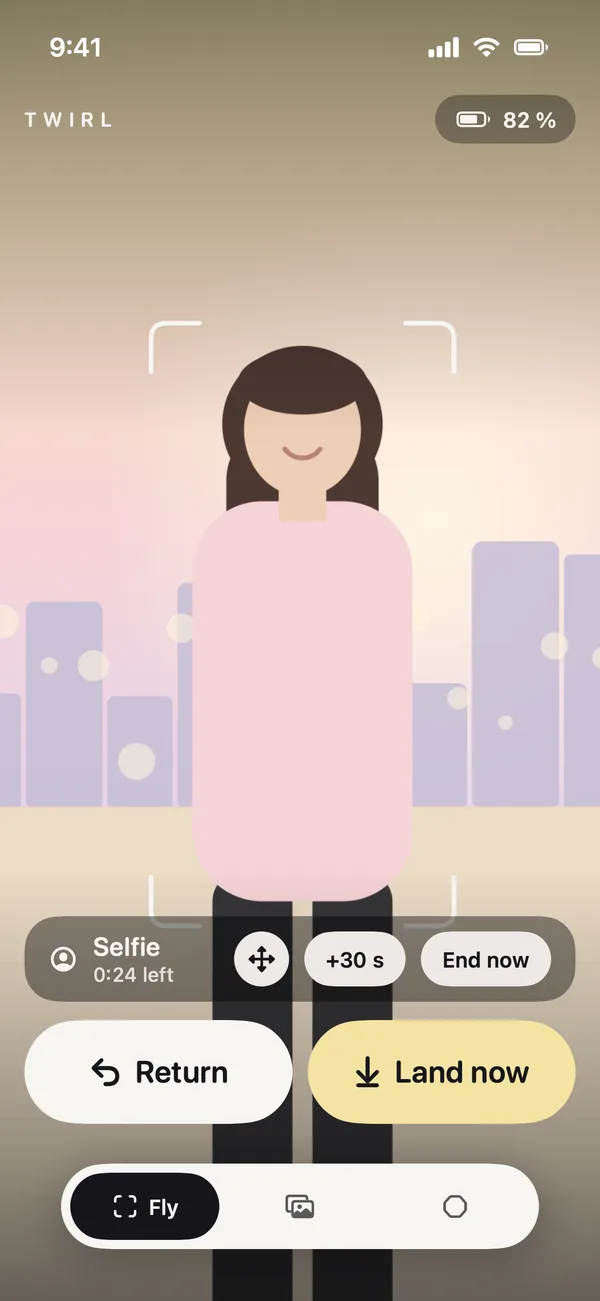
You pick how long in the app. In flight you have +30 s and End now. Every run ends with Twirl coming home on its own.

The Fly screen during a run: live view from the camera, the run card with the time left above the Return and Land now buttons.

The full stack · The app

The app lives on the phone you already carry.

The plan is iPhone first, then Android. The iPhone app is native, and we are building it without third-party code.

Live view
From the moment Twirl wakes
Run picker
Eight runs, with the look and how many photos to keep
In flight
Return and Land now, one tap each, plus +30 s and End now
Restricted areas
Checked on your phone before every flight
Photos
Checked on arrival, saved to your camera roll, then deleted from Twirl
Your library
The app can add photos. It does not read your others
Looks
Natural · Flash · Grain, added on your phone with the original kept
Account
None to make. Nothing is shared unless you choose to

Tour the app

All of it, for this

One toss. Your hands stay free until Twirl comes home.

Four motors, two chips and close-range sensing on every side, so the only thing you think about is the sunset.

Where it stands

Coming Soon

A lot of tech. One toss.

Join the list for news as Twirl comes together.

Join the list See how it flies